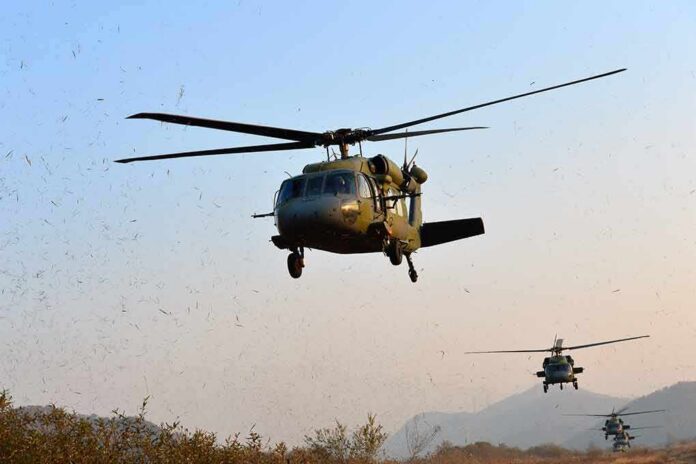
A dramatic Texas flood rescue shows local helicopter heroes saving lives while bigger bureaucracies argue over numbers.
Story Snapshot
- Travis County’s STAR Flight helicopter crew rescued nine people and two dogs from dangerous floodwaters.
- A viral video from Gillespie County shows a man hoisted to safety as raging water slams into a flooded building.
- Texas Army and Air National Guard teams rescued more than 525 people during the wider flood disaster.
- Media reports highlight statewide totals but often blur how much credit local crews like STAR Flight truly deserve.
Helicopter Heroes In Central Texas Flood Chaos
Travis County’s official emergency helicopter program, known as STAR Flight, has once again proven why local first responders matter when disaster strikes. STAR Flight is an agency of the Travis County government that flies air ambulance and search and rescue missions, and also helps with firefighting and law enforcement support. During recent violent flooding in Central Texas, these crews went straight into danger while many agencies were still counting victims and writing talking points.
Fox 7 Austin reports that first responders in Travis County faced a busy night as flash floods turned roads and neighborhoods into rivers. In that operation, STAR Flight crews rescued nine people and two dogs from flooded roads and homes, using hoist systems and careful flight work in rough weather. Each rescue meant hovering over fast-moving water, lowering a rescuer on a cable, and lifting victims out before currents or debris could sweep them away.
Gillespie County Rescue And Viral Video Spotlight
As floodwaters tore through the Hill Country, STAR Flight did not stay inside county lines. The program is funded by Travis County but routinely supports neighboring rural counties that lack this kind of helicopter capability. In Gillespie County, video shared by officials shows an aerial crew rescuing a man from a building that had taken on several feet of water, with brown floodwater smashing against the walls as he was hoisted into the aircraft. That clip raced across social media, giving Texans a rare close look at what these rescues really demand.
The Gillespie County mission highlights a basic truth many conservatives know well: local teams step up first while distant agencies argue over plans and press releases. STAR Flight has built its reputation on multi-mission capability, with crews trained for medical transport, hoist rescues, firefighting, and law enforcement support. That flexibility matters in rural Texas, where flood victims can be trapped in barns, river cabins, or low-water crossings miles from a fire station. When water rises fast, a helicopter and a steel cable may be the only lifeline.
Massive Statewide Operation And Murky Credit
At the same time, Texas mounted a huge joint response using the Texas Army National Guard and Texas Air National Guard. Reporting on the July floods shows that Guard teams rescued more than 525 people by July 8, with 366 airlifted in Black Hawk helicopters and 159 rescued by ground crews. STAR Flight supported this broader effort with hoist rescues, aerial searches, and supply missions, acting as a local partner inside a much larger rescue machine. Together, these operations saved hundreds of lives across the Hill Country.
Yet as often happens in big disasters, media coverage tends to lump all helicopter rescues into one statewide total. Reports give the big number for Guard missions but rarely separate out how many lives were saved specifically by STAR Flight. That makes it hard for citizens to see the true impact of a county-run program they help fund. It also feeds confusion on social media, where some posts claim large rescue counts for STAR Flight without linking to clear official logs or press releases that back up those exact numbers.
Life And Death Stakes For Flood Victims
The Texas Hill Country flooding was not just a dramatic video event; it cost lives. CBS Austin reported that at least one person died in the Hill Country floods, and state leaders confirmed multiple deaths in the region during briefings. Fast-rising rivers, narrow canyons, and crowded campgrounds turned a holiday into tragedy. In that context, every successful helicopter hoist matters, because it can mean the difference between a survivor and another name on a list read at a press conference.
🚁 Our Travis County STAR Flight dispatched to the Hill Country yesterday (7/16). This is a water rescue in Gillespie County.
We are incredibly grateful to all first responders who continue working tirelessly to protect lives during this flooding event. 💙 pic.twitter.com/B8zAFb3uQI
— Travis County Emergency Services (@TravisCountyES) July 17, 2026
For conservative readers who value strong local government and personal responsibility, the STAR Flight story carries a clear lesson. Prepared counties that invest in real capabilities—trained crews, hoist-equipped helicopters, and 24/7 operations—save lives when nature or mismanagement turns deadly. While federal agencies and statewide commands debate budgets, alerts, and regulations, STAR Flight crews strap in, launch into storms, and bring stranded Texans home. Honoring that work means demanding honest numbers, clear credit, and continued support for local rescue programs that prove their worth in every flood.
Sources:
facebook.com, verticalmag.com, traviscountyhistory.org, cbsaustin.com, traviscountytx.gov