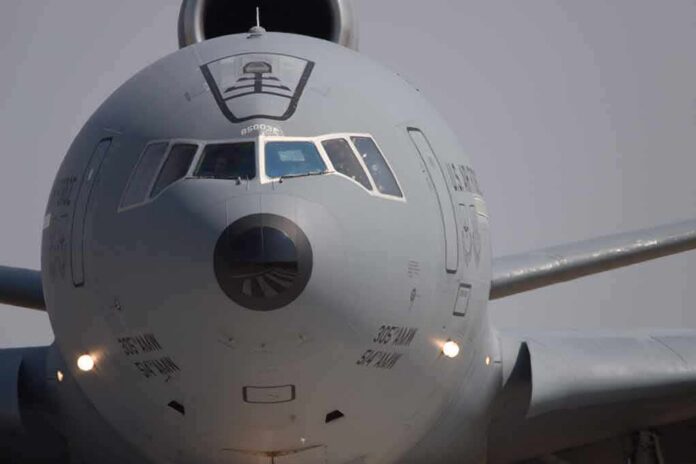
Bulgaria has opened its Bezmer Air Base to U.S. refueling jets supporting strikes on Iran, while insisting no combat will launch from its soil.
Story Snapshot
- Bulgaria’s parliament approved up to eight U.S. KC-135 tankers and 250 troops at Bezmer Air Base to back U.S. operations in the Middle East.
- Sofia claims the mission is “solely logistical,” with no combat flights or strikes launched from Bulgarian territory.
- Iran has warned Bulgaria that hosting U.S. tankers makes it complicit in “aggression and war crimes” in the Iran conflict.
- The Trump administration gains a key NATO staging point near the Black Sea for sustained air operations against Iran.
Parliament Greenlights U.S. Tankers at Bezmer Air Base
Bulgarian lawmakers have voted to let the United States station refueling aircraft and troops at Bezmer Air Base to support American operations in the Middle East. The authorization allows up to eight KC-135 tanker jets and about 250 U.S. military personnel with their equipment from July 24 to October 1, 2026. The vote was clear and strong, with 136 members in favor, 13 against, and two abstentions, underscoring Bulgaria’s decision to stand by its defense ties with Washington.
Prime Minister Rumen Radev told parliament and his cabinet that the deployment meets Bulgaria’s “allied commitments” under its 2006 defense cooperation agreement with the United States. That agreement already gives U.S. forces access to several Bulgarian military facilities, including Bezmer, but new uses still require a parliamentary vote. By framing the move as honoring a standing pact, the government is signaling that this is a planned alliance duty, not an improvised step into a new war.
Sofia Insists: Logistics Support, Not Combat Operations
Prime Minister Radev has stressed that no combat operations in the Middle East will be launched from Bulgarian territory. He told ministers that the KC-135 tankers are intended solely for logistical missions, performing in-flight refueling outside Bulgarian airspace rather than joining strike packages overhead. Bulgarian officials say no offensive weapons systems will be deployed at Bezmer, and the aircraft will not carry bombs or missiles, a line aimed at calming public fears and answering foreign criticism.
Bulgarian President Iliana Iotova has echoed that stance, saying that hosting up to eight U.S. refueling aircraft and 250 personnel would not make Bulgaria a party to the military action in Iran. She emphasized that parliamentary approval was required by law and that the deployment falls within existing defense cooperation, even if it supports a live U.S. operation. This is a familiar pattern in alliance politics: leaders argue that providing basing and logistics is different from direct combat, even when those services clearly help their ally wage war.
Iran Warns Bulgaria, While Washington Builds Reach on Iran
Tehran has warned Bulgaria against allowing U.S. forces to use its territory for military operations against Iran, claiming the move would make Sofia complicit in “aggression and war crimes.” Iranian statements argue that refueling support is part of the war machine and that host nations cannot wash their hands of responsibility once their airfields and airspace enable U.S. sorties. These warnings fit a broader Iranian effort to pressure U.S. partners and raise the political cost of backing American strikes.
For the Trump administration, the Bezmer decision is a practical win that extends U.S. reach and endurance over Iran from a friendly NATO platform near the Black Sea. KC-135 tankers operating out of Bulgaria can keep strike and patrol aircraft in the air longer and reduce the need to rely only on Gulf bases, which face their own political and security risks. From a conservative U.S. perspective, this is exactly how alliances should work: American leadership backed by willing partners who provide real, concrete support when the stakes are high.
Domestic Unease and What It Means for U.S. Patriots
Inside Bulgaria, some lawmakers and analysts worry that even “logistics only” support pulls their country deeper into the Iran conflict. Critics point out that tanker planes directly enable combat missions by letting strike jets reach targets and return safely, blurring the neat line between logistics and warfare. Yet the government’s formal position remains firm: Bulgaria is not launching attacks, is not at war with Iran, and is simply honoring its commitments as a North Atlantic Treaty Organization ally.
For American readers who care about strong defense and limited foreign entanglements, this story shows both the power and cost of alliances. On one hand, a small European partner is stepping up, giving our military the fuel and access it needs to confront a hostile regime racing for nuclear power. On the other, the legal and political debate in Sofia is a reminder that every base, every overflight, and every tanker comes with questions about sovereignty, risk, and how far non‑combat support goes toward joining a war.
Sources:
realcleardefense.com, bta.bg, sofiaglobe.com, english.alarabiya.net, en.haberler.com, bloomberg.com, novinite.com, sfgate.com, defensenews.com