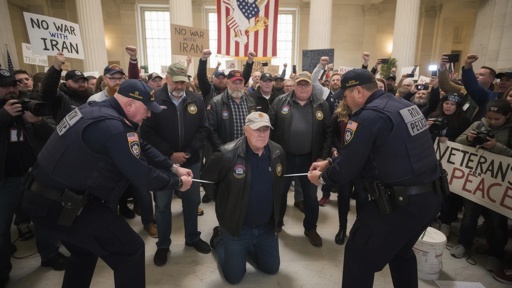
Sixty-two American military veterans, some disabled and in fatigues, were zip-tied and arrested inside the Capitol after staging a dramatic flag-folding ceremony to protest a war they say betrays the very principles they once fought to defend.
When Warriors Turn Against War Makers
The Cannon House Office Building rotunda became an arena of conscience on Monday as men and women who once answered their nation’s call now demanded accountability from those issuing orders. Veterans clad in military fatigues stood at attention, executing a precise flag-folding ceremony typically reserved for fallen soldiers’ funerals. This wasn’t theater. These were Americans who earned the right to question through service, honoring comrades lost while holding red tulips symbolizing Iranian lives extinguished in a conflict they believe serves neither country’s interest. Their message cut through political noise: stop funding this war.
The protest wasn’t spontaneous rage but calculated civil disobedience. About Face, Veterans For Peace, Common Defense, and other veteran organizations coordinated the action, unfurling banners declaring “End the War on Iran” and “We Can’t Afford Another War.” They chanted demands directly at House Speaker Mike Johnson, the gatekeeper of war appropriations. When Capitol Police issued dispersal orders, the veterans refused, accepting arrest as the price of moral witness. Sixty-two were led away in zip ties, their defiance captured on video that broadcast their conviction beyond the marble halls where policy gets made and consequences get ignored.
The War Nobody Asked For
The conflict these veterans oppose began February 28 as a joint US-Israeli operation against Iran under the Trump-Netanyahu alliance. American strikes have killed Iranian civilians, and the specter of dead American troops haunts every escalation. Iraq War veteran Mike Prysner, speaking for the protesters, framed the war as “deeply unpopular” and an “administration crisis,” language that reflects polling realities politicians prefer to dismiss. The protesters aren’t pacifists disconnected from military realities; they’re combat veterans who understand war’s costs in blood and treasure, challenging a policy they see as reckless adventurism wrapped in security rhetoric.
This dissent carries weight because it originates from those who bore the burden of previous Middle East interventions. The Iraq and Afghanistan wars taught hard lessons about mission creep, flawed intelligence, and conflicts that devour resources while producing ambiguous outcomes. These veterans see history repeating, with American forces deployed in another regional powder keg where vital interests remain undefined and exit strategies nonexistent. Their protest inside the heart of congressional power wasn’t just symbolic; it was veterans exercising citizenship by confronting lawmakers who fund wars from the safety of air-conditioned offices while others face the consequences in distant combat zones.
Authority Versus Accountability
The power dynamic on display was stark. Veterans with moral authority earned through service faced Capitol Police with enforcement authority derived from institutional power. The arrests were orderly and predictable, yet they exposed uncomfortable questions about who holds lawmakers accountable when wars become unpopular. These protesters targeted Congress because that’s where funding originates, the constitutional lever that should constrain executive military action but rarely does. By risking arrest, they forced attention on a war many Americans barely know exists, conducted in their name with their tax dollars while economic pressures mount domestically.
The coalition included disabled veterans whose physical sacrifice gives their opposition particular resonance. Military Families Speak Out and other organizations brought relatives of service members, expanding the moral circle beyond those who served to those who wait and worry. This wasn’t fringe activism but organized dissent from within the military community, people conservative Americans typically respect and politicians claim to honor. When such voices declare a war unjust and unaffordable, dismissing them as uninformed becomes impossible. Their service record is their credential, and their willingness to face arrest demonstrates commitment politicians should find sobering.
The Cost of Ignoring Dissent
The protest occurred as ceasefire negotiations face a critical deadline, suggesting timing calculated for maximum impact. Whether these arrests translate into policy change depends on whether Congress recognizes legitimate dissent or treats it as noise to be suppressed. The Trump administration initiated this conflict, and Netanyahu’s government has strategic interests that may not align with American welfare. Veterans questioning this partnership aren’t undermining national security; they’re performing the citizenship duty to scrutinize whether leaders are spending American lives and resources wisely. That’s not rebellion; that’s responsibility the Founders would recognize.
No charges have been announced yet for the 62 arrested, but the legal consequences pale beside the larger questions raised. Can America afford another Middle East war when infrastructure crumbles and debt explodes? Do we trust the same leadership class that bungled Iraq and Afghanistan to navigate Iranian complexities? These veterans answered no with their bodies, forcing an issue Washington would prefer to manage quietly. Their protest won’t end the war tomorrow, but it placed military dissent on record, creating space for Americans exhausted by endless conflicts to question why we keep repeating mistakes. That’s a conversation worth having, even if it requires handcuffs to start it.