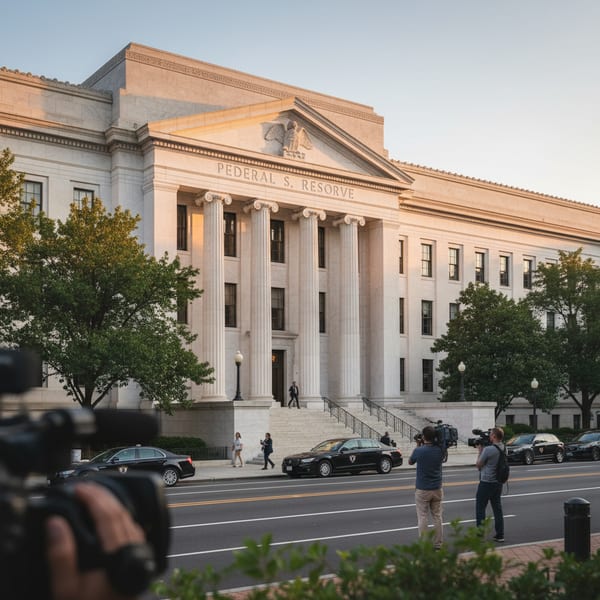
Three Federal Reserve officials publicly challenged their colleagues this week, arguing the central bank should stop signaling future interest rate cuts as Middle East conflict threatens to push inflation higher and destabilize the American economy.
Historic Disagreement at the Fed
The Federal Open Market Committee vote Wednesday marked the first time since 1992 that four officials dissented against a policy decision. Three officials opposed the statement’s language suggesting the Fed’s next move would likely be a rate cut, while Fed Governor Stephen Miran dissented in the opposite direction, preferring an immediate quarter-point rate reduction. Officials kept the benchmark rate unchanged at 3.5% to 3.75% after three cuts at the end of 2025.

More Here → m.piqsuite.com/?widget-articl…

Kashkari Warns of Two Troubling Scenarios
Minneapolis Fed President Neel Kashkari, casting his fifth dissent, outlined two potential outcomes from the Middle East conflict. If the Strait of Hormuz reopens quickly, underlying inflation would likely stay around 3% for a third consecutive year, pressuring American consumers and workers. If the conflict continues, both inflation and unemployment could rise simultaneously. Given inflation has exceeded the Fed’s target for five years, Kashkari warned this could require rate increases, even at the risk of further labor market weakness.
Cleveland Fed President Beth Hammack echoed concerns about broad-based inflationary pressures, noting the economy has remained resilient despite rising oil prices. She emphasized that uncertainty around the economic outlook has increased substantially in 2026, creating upside risks to inflation and downside risks to growth and employment. Hammack previously dissented in December 2024 to oppose a quarter-point rate reduction.
What This Means for Americans
The disagreement centers on a single phrase in the Fed’s statement referring to the extent and timing of additional adjustments to rates. Since January, a growing number of officials have urged colleagues to clarify that the Fed’s next move could be a rate hike rather than a cut. Dallas Fed President Lori Logan, dissenting for the first time since becoming president in 2022, emphasized that forward guidance itself functions as an important policy tool affecting financial conditions. Elevated fuel costs driven by conflict with Iran have raised worries that price pressures could spread throughout the economy, threatening household budgets and American prosperity.