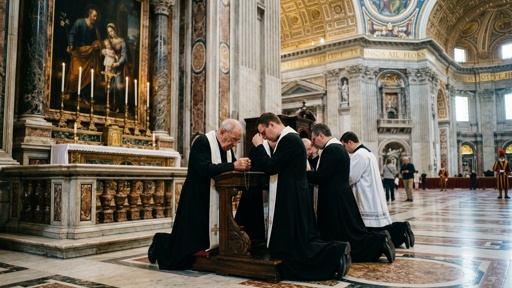
The Vatican just handed one of America’s most rural dioceses to a bishop whose biography will collide head-on with Washington’s immigration battles.
Pope Leo XIV’s May 1 reshuffle puts West Virginia in the spotlight
Pope Leo XIV announced on May 1, 2026, that Bishop Mark E. Brennan will step down as leader of the Diocese of Wheeling-Charleston and that Auxiliary Bishop Evelio Menjivar-Ayala of Washington will succeed him. Catholic outlets described the move as a reshaping of leadership with ties to Baltimore and Washington, reflecting the Vatican’s direct authority over episcopal appointments. The transition is official, with installation timing pending the usual Church procedures.
Brennan’s U.S. Church path has intersected multiple regions. He was ordained an auxiliary bishop in Baltimore on Jan. 19, 2017, and later transferred to West Virginia on July 23, 2019. Coverage of the transition also highlighted Brennan’s immigrant outreach language, including a pastoral message reminding immigrants that they are part of the Church’s life, not outsiders. Those themes now frame public expectations for the diocese’s next chapter.
A first-of-its-kind résumé: undocumented entry, manual labor, then the episcopacy
Menjivar-Ayala’s background is the headline for many Americans because it crosses the same border-policy fault lines voters have argued about for years. Reporting states he entered the United States undocumented, worked manual labor, and learned English as a second language before eventually being ordained. He became a priest for the Archdiocese of Washington on May 29, 2004, after studies in Miami and Rome, and he later rose into senior leadership.
Menjivar-Ayala was ordained an auxiliary bishop in Washington in February 2023 by Cardinal Wilton D. Gregory, and he is widely described as the first Salvadoran bishop in the U.S. He is also reported to speak English, Spanish, and Italian, and his academic and pastoral focus includes migration and “human mobility” ministry. Those credentials signal the kind of bishop Pope Leo XIV appears to favor amid global debates over migration.
Why the appointment lands differently under Trump’s second term
In 2026, the federal government’s actions on immigration enforcement, spending, and border security are owned by the sitting administration, not previous leadership. That makes the timing of this appointment especially sensitive: it is likely to be read through the lens of the current political climate rather than treated as an internal Church story. Some coverage framed the selection as countercultural in a Trump-era context, while still emphasizing it as a Vatican decision.
The available research does not include direct public statements from the White House, the Diocese of Wheeling-Charleston, or Menjivar-Ayala responding to the politics around his personal history. What is clear is the tension many conservatives feel: Americans can support legal immigration and also insist that illegal entry should not be normalized or treated as a credential. The Church’s choice does not change U.S. law, but it can influence advocacy and rhetoric.
A vast, rural diocese and a national debate: what actually changes on the ground
The Diocese of Wheeling-Charleston is West Virginia’s only Catholic jurisdiction, established in 1850, and it covers the entire state—24,000 square miles and roughly 1.81 million residents. That scale matters more than headlines because a bishop’s day-to-day job is governance: staffing parishes, supporting priests, supervising schools and ministries, and keeping sacraments available across long distances. Those realities often define a bishop’s legacy more than national politics.
Still, symbols carry weight. Menjivar-Ayala’s appointment is already being interpreted as a signal of Vatican priorities that emphasize immigrant inclusion and leadership drawn from global and migrant communities. The research also suggests his migration-focused training could shape pastoral initiatives and public advocacy. How far that goes is uncertain, because installation details, policy priorities, and local reception have not been fully reported in the provided sources.
Pope Leo picks formerly undocumented immigrant to lead West Virginia Catholics, via @mboorstein https://t.co/m09pGnICO7
— Cathleen Decker (@cathleendecker) May 1, 2026
For West Virginia Catholics, the near-term question is practical: how quickly the transition stabilizes leadership and whether the next bishop can connect with a largely rural flock while navigating the national noise. For the broader country, the story is a reminder that powerful institutions can send messages that affect civic debates—especially when those messages intersect with immigration, sovereignty, and the rule of law. The facts so far show an appointment; the bigger argument will be written in reactions.
Sources:
Pope Leo XIV reshapes Washington, W.Va. leadership; two bishops have Baltimore ties
Pope Leo XIV sends former undocumented